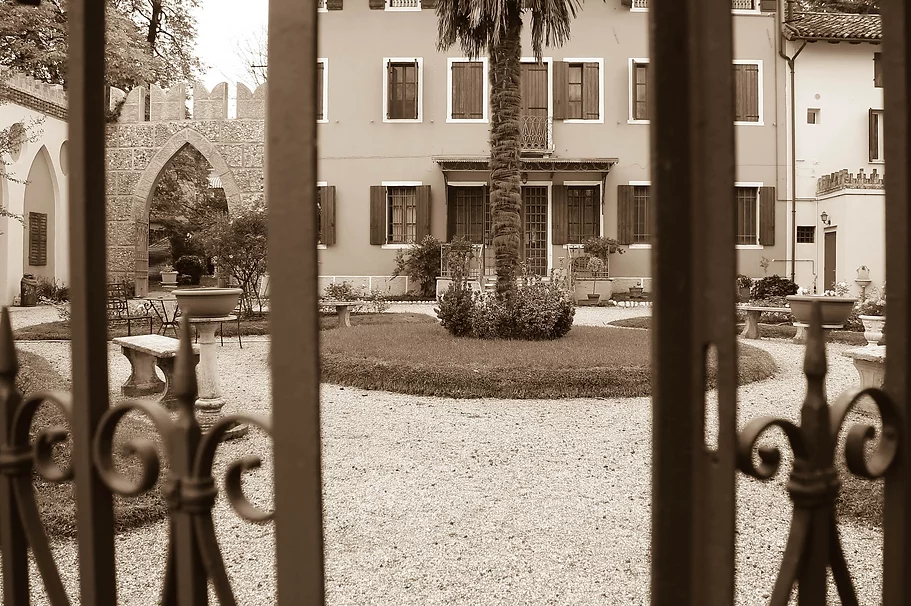


The manor house, of typical Venetian design, probably from the 16th century, is spread over three floors and is covered by a pavilion roof. The building took on its current appearance following the restoration of 1827 and is surrounded by an open park area of 4500 m² where you can admire various centenary tree species including oaks, palms, yews andlaburnum.
The interior has maintained its nineteenth-century appearance with original furnishings and tempera paintings that decorate the main hall from the end of the nineteenth century. The fusion between the objects that the ancient family has collected over the centuries and the centuries-old trees in the park creates a suggestive atmosphere that brings to mind the harmony of times gone by.
According to some studies, the park, which reflects the typical style of the Italian garden, was the place where the painter Gregorio Lazzarini (1655 -1730), master of the more famous GB Tiepolo, began to paint.
| Currently the residence is owned by the same family who bought it at the end of the 19th century. Nicolò Bornancini, mayor of Cinto Caomaggiore and landowner, had bought the villa on the occasion of his marriage to Countess Anita Bombarda, originally from Portovecchio near Portogruaro. The Cav. Nicolò Bornancini chose this villa as a wedding gift. Unfortunately, his wife Anita died two years after giving birth to a child, Caterina. |
|

| The knight Bombarda took home a French governess M.me Chappe who took care of her daughter's education. Caterina, who like all the girls from a good family of the time, learned to play the piano thanks to maestro Goffredo Giarda of the Benedetto Marcello conservatory in Venice, who was a great friend of the poet Gabriele D'Annunzio. |
|


After the death of her father, Mrs. Caterina Bornancini lived in the villa with her husband Ottavio Cincotta, general of the of the Royal Air Force and cousin of the famous Neapolitan singer Giacomo Rondinella. The current interior decoration |
|


 |
The current owner, Dr. Nicoletta Bulian is a guide and tour leader in the Veneto region, speaks English, German, French and Spanishand mainly deals with making the territory known to foreign groups as well.
|

The existence of a community in Cinto is documented for the first time in a document from 1192, in which the patriarch of Aquileia Godoberto donates six mansi to be deforested in the Cinto forest. The name is therefore closely associated with the wooded nature of the surrounding area, the so-called Waldum or the large lowland forest that still occupied vast territories of the Po Valley. If for the name of the town we refer to this important document from the 12th century, some important archaeological findings allow us to date the first human settlements in the area to much more distant times.
Two Neolithic axes confirm that the territory on which Cinto is now located was frequented more than 4000 years ago, probably by nomadic hunters who stopped here only part of the year, following the movements of the herds of wild animals.
An ancient Greek marble “patera” depicting in relief an eagle pecking a hare on the head, inserted in the external walls of Villa Bornancini and dating back to between the 12th and 13th centuries, is the oldest find today visible on the territory. It probably once decorated the external walls of a place of worship or an important civic building.