
Introduction
Along country paths, to rediscover meadows, groves, banks, hedges: this itinerary is entirely dedicated to natural landscapes, which still remain in our territory thanks also to the generous and intelligent commitment of many volunteers. The robin, symbol of the route, in fact testifies to the need and urgency of conserving these places, which are essential to the life of all the small animals that make up the local fauna. All this can constitute a small but significant contribution towards environmental balance and the recovery of habitats endangered by development that is not always sustainable. With the hope that this journey will also be a cause for reflection, everyone... have a good ride!
Description of the route (km 26)
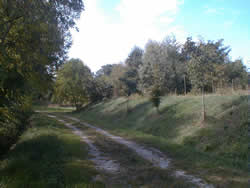 Our itinerary begins at the Peace Park of Portogruaro. Once out of the park, turn left onto Via Seminario, continue until the roundabout and cross the cycle path on the right to enter Viale Isonzo. Continue for 600 meters until the large curve, turn left into Via G. Galilei and continue straight until Via Villastorta; then turn left and after the roundabout continue along Via Villastorta for 750 metres. Then take Via Sante Conti; then turn right into Via Nosedo (the last stretch of Via Nosedo is dirt), enter right into Via Fossalato for only 100 meters and immediately turn left into Via Colombara. Continue (the road returns to dirt) and cross the motorway using the underpass; turn right alongside the motorway towards Trieste for two kilometres; at the end of the dirt road, turn left onto Via Edmondo De Amicis. At the end of the street (after 850 metres) you find yourself in front of a Tabernacle dedicated to the Blessed Virgin Mary; turn right towards Teglio Veneto, in Via Portogruaro, arriving in the center of the town. via Nosedo Take Via Parz between the small church of Sant'Antonio Abate and the tabernacle of San Gregorio and continue for about three kilometers (part of this road is dirt) reaching the Prati delle Pars. Go back for about 1200 meters and turn left onto a country road without signs (this road connects Via Parz with Via Perarutto). At the end of the road, turn left for 50 meters and then right onto Via Casermette, returning to the asphalt, leaving a small disused barracks behind. Continue towards the overpass on the motorway and from the overpass you can already see, on the left side, the Alvisopoli Forest. via Perarutto Once you reach the stop sign, turn left to reach Alvisopoli with just a few pedals, where the forest of the same name and Villa Mocenigo are located. From Alvisopoli you reach Fossalta di Portogruaro via a cycle path that runs alongside a long straight road (first Via Mocenigo, then Viale Trieste); about halfway, you can see the small church of San Biagio on the right. Once in Fossalta, turn right into Via Callalta, cross Piazza Risorgimento, turn left into Via L. Zannier continuing for about 100 metres; turn right onto Viale Venezia and, after 250 metres, you need to pay attention and take a dirt road on the right which has no particular signs. You continue pedaling for about 500 meters to reach the Bosco delle Roiate. Another 400 meters or so and you return to the asphalt road, taking Via Damiano Chiesa on the right. After about a kilometre, an old wash house in Valladis, recently rebuilt, can be seen on the right. Continue along Via Valladis to reach Via Fossalato. Turn left, continue for another 700 metres; at this point you need to be very careful and take a country road on the left with a no access sign for non-agricultural motorized vehicles, which connects Via Fossalato with Via Villastorta. Finally, turn right onto Via Villastorta, taking the asphalt road again and thus returning to Portogruaro.
Peace Park - Portogruaro
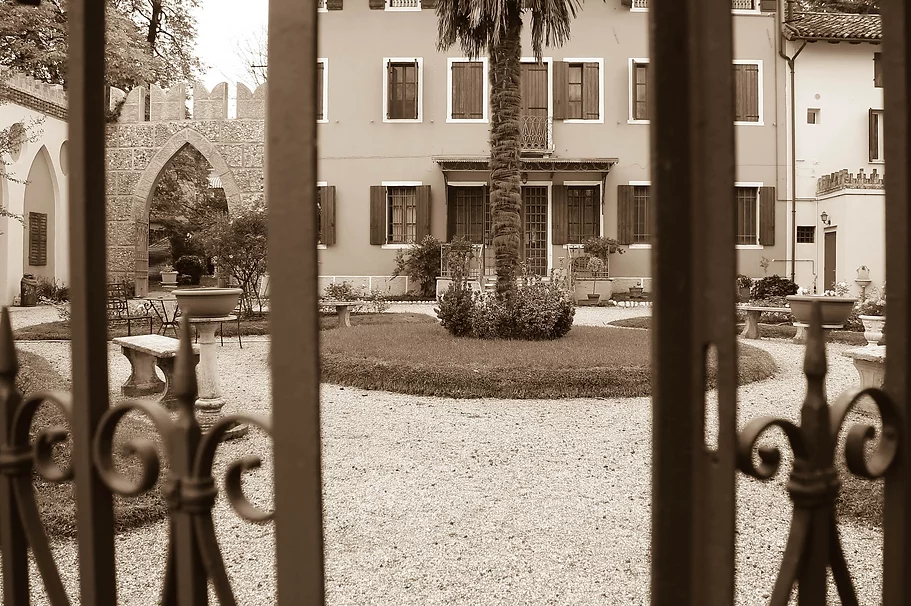
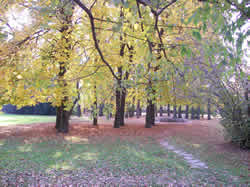 Located in the center of the city, the garden of the historic villa, formerly owned by Stucki and Marzotto, has been used as a public park in recent decades. On May 1st 2006, the day dedicated by the city of Portogruaro to Peace, the park was renamed with its current name.
Inside you can admire some notable tree species, among which the old and majestic elm stands out, approximately 30 meters high, located in the eastern part of the garden, near the surrounding wall.
Sant'Antonio Abate - Teglio Veneto
 The small temple, dedicated to Sant'Antonio Abate, dates back to around 450 years ago; it was recently and entirely renovated and frescoed by Mr. Ernesto Nosella, local resident. Inside, in addition to the Altar, you can see important signs of popular religiosity: next to a statue of the Madonna, there are images dedicated to Sant'Antonio da Padova, Sant'Antonio Abate and San Rocco.
Pars meadows
This large area has been subject, in recent years, to numerous renaturation interventions, which make it an area of particular ecological/naturalistic value; of particular interest in this regard are the hedges, entirely made up of native species.
It is important to remember that these interventions are the result of voluntary work carried out by members of the "Prati dei Pars" Association. For more detailed information, please refer to the website www.pratidellepars.it
Alvisopoli Forest and Villa Mocenigo
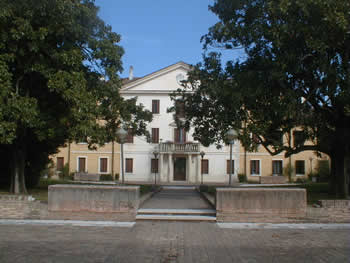 Founded by Alvise Mocenigo at the beginning of the 19th century, the village of Alvisopoli still retains its particular physiognomy and its original buildings. Among these, the main villa with its colonnaded wings, the ruins of the rice husking mill and the church of San Luigi Gonzaga stand out. entrance to the Alvisopoli forest. Of particular interest is the garden of the complex, adjacent to the Taglio canal, consisting of a remnant of an ancient lowland forest, transformed by the noble Mocenigo into a splendid park full of native and exotic plants. Given its character as a naturalistic oasis in the midst of intensely cultivated fields, the forest is also home to numerous varieties of fauna. It is currently managed by the Portogruaro section of the WWF.
Fossalta di Portogruaro
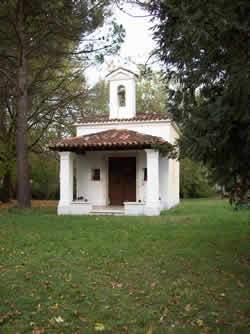 Along the straight road that connects Alvisopoli to Fossalta, you come across the small church dedicated to San Biagio. The small building is immediately recognizable for the portico in front of the facade and for the bell tower with bell. The surrounding green area is particularly evocative. The date of its foundation is uncertain between the 15th and 16th centuries.
Roiate Forest
The Roiate site presents itself as an interesting example of environmental recovery. Bosco delle RoiateUsed as a municipal landfill until 1991, it appeared to be an area highly compromised from a naturalistic point of view, and poor in spontaneous vegetation. Along the country road that leads from Fossalta to the forest, the first reclamation and restoration intervention took place already in 1991 by the F.I.d.C. Hunters Section. of Fossalta di Portogruaro and other volunteers. In 2002 the municipal administration added a further plot of land to the area, thus giving rise to the current "Bosco delle Roiate". Bosco delle RoiateThe place is all the more interesting as inside it is possible to see ancient and rare examples of native vineyards and fruit trees, which have now disappeared from cultivation, such as the Clinto, Fragola, Bacò and Raboso vines and numerous varieties of apricots, peaches , plums, apples, pears, figs, medlars and cherries. The route follows the old road which, already at the time of Austrian domination, connected the municipalities of Fossalta and Portogruaro. On the occasion of May 1st, in the shade of these mulberry trees, it is now tradition to organize the "Bosco in festa" event, in which a considerable number of citizens from all over the province and from nearby Friuli participate.
Map
